Showing posts with label refined sugar-free. Show all posts

Tuesday, January 13, 2015

Chả Lụa | Silky pork sausage


Chả Lụa is a classic & ubiquitous Viet sausage roll that is traditionally pounded into a silky paste, wrapped in banana leaves, and boiled. It's found in bánh mì | VN sandwiches, bánh cuốn | rice rolls, among many other dishes. Like deli meat it can be eaten as a snack; one of my favorite ways to eat it is a mini-sandwich with bánh dầy | mochi.

Typical store-made Chả Lụa has MSG/hydrolyzed wheat protein and potato-/wheat-/cornstarch (likely GMO) and they also wrap the roll with a final layer of plastic wrap  or aluminum foil before boiling or use nylon twine--all of which release toxins/carcinogens when heated. So Chả Lụa has been off my menu for several years now unless I've got my additive-busting supplements with me.

This was a team effort. My thoughtful husband made the first batch when I was enduring first trimester ravening hunger pangs. I made the next round.

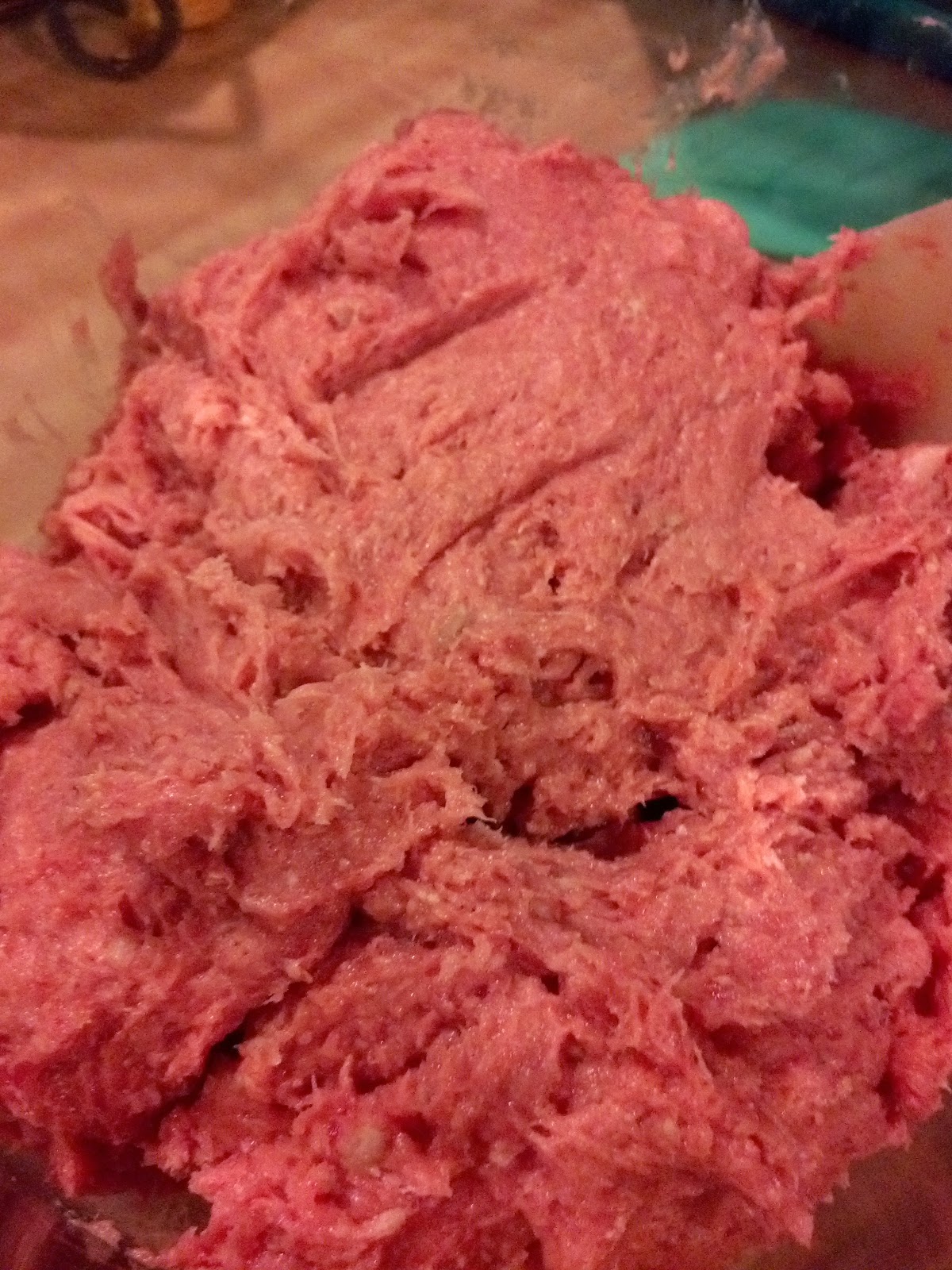
Like many of these traditional dishes that seem so challenging, I found that making Chả Lụa itself was not hard, but it required time investment in the wrapping & cooking. Because I like my modern tools, I used a food processor to render the meat and fat into a paste (similar to what one would do for meatballs). It only takes 10-15 minutes to get through 3 lbs. Easy peasy. We tried the grinder and it was double the work to then process the grind, so skip that step altogether. 

The first round, my husband tried the recipe from Bach Ngo's The Classic Cuisine of Vietnam; he wrapped with one layer of banana leaf and boiled the 3-4 rolls for 40 minutes. We ended up with a lot of waterlogged rolls. It was a good effort, but even without the waterlogging, why add water to recipe and then starch to firm in the first place? Also it was not salty or flavorful enough but that could be the waterlogging issue. The next time, I eyeballed Charles Phan's recipe and considered it too plain (only 2 tbs of fish sauce?!), pork belly too fatty and more headcheese-like with pork belly skin-on, which is a different and also delicious variety of Chả Lụa  called chả bì. So I fused some of the simplicity of Phan (added salt, no water, no starch, no additional refrigeration) with Ngo's recipe (more fish sauce, baby!), and per my usual modus operandi, we used higher quality ingredients. I believe the quality of the ingredients truly makes or breaks a recipe. 

The trickiest part is wrapping it to make it waterproof. We can source fresh banana leaves in the Bay Area at Latino/Caribbean markets or people's gardens, but typically I buy the frozen imported kind at the Viet or Latino markets. The banana leaves need to be rinsed and wiped down to remove any chalky residue. My mom recommends blanching the defrosted banana leaves in boiling water to make them more pliable, less likely to tear. [2/1/2015 note: Mom also says use banana leaves from Thailand, not the Philippines and to cut off the rib for pliability.]

We are still working on wrapping technique; I used double or triple banana leaf layers and wrapped it like a burrito (i.e. rolled and tucked in the ends which are held in place by twine). I only used a single criss cross which was't snug enough; I would recommend the roast tying method. I also went with Phan's steam cooking to reduce the waterlogging though I employed my pressure cooker to shortcut the time.

I picked up nice country ribs (butt) from Whole Foods; this is a flavorful fatty cut from sustainably raised pork and in the bulk pack (3 lbs+) it's a reasonably priced $4.99/lb comparable to what one would get buying direct from the farmer. If you must use conventionally-raised pork, my mom recommends soaking it with lemon juice and water overnight to "sweeten" the meat before marinading. The acidulation helps to break down the tough meat fibers from of chemically laden, stressed out pigs.


If the banana leaves are too much for you, I suppose one could substitute parchment paper though I have never tried it. Also, you can shape these into 1.5 inch balls (invest in a cookie scoop!) and make Thịt viên | meatballs. Easy peasy lemon squeezy. Boil in water until cooked through before adding to soups, noodle dishes etc. Freeze the extras.

Ingredients

(Makes 3 rolls)

1.5 tsp unrefined sea salt (Celtic/grey or Himalayan/pink)
1.5 tsp fresh ground organic black pepper
1 tbs organic coconut palm sugar
1 tbs baking soda
6 tbs Red Boat fish sauce

3 lbs sustainably raised pork country ribs (butt), cut into 1.5 inch squares

1-2 tbs of fish sauce
1-2 packages of frozen banana leaves, cleaned, blanched, and wiped dry
kitchen twine (each strand should be 4-5 lengths of the roll)

In a  bowl, mix all the marinade ingredients together. Toss the cubed meat with the  marinade. In the ideal world, marinade for 4 hours. 

Working with small batches, use a food processor or a very high powered blender to make a fine meat paste (approx 3 minutes of processing) and reserve in a large bowl. Add any leftover marinade juices and mix in. Work quickly to keep the paste cold. When it warms, the fat melts making it more difficult to roll.

Lay out the banana leaves on a tray or cutting board. You will need 2-3 layers of leaves. Use 1/3 of the meat paste and shape into a cylindrical roll. Use a silicone pastry brush and brush with fish sauce. Roll snugly in the banana leaves, adding more leaves to patch any tears. Fold down the ends and tie with twine using the roast method.

Steam in a pressure cooker for 40-60 minutes. Steam in a regular pot for 1.5 hours or boil for 40 minutes. (If you make smaller rolls, it'll need less cooking time.) The interior should be cooked through--that greige meatball color. Some pink is okay if you are using sustainably raised meat.

Slice as needed. Store uneaten roll whole in banana leaves in an airtight container in the fridge. Extra rolls can be frozen, banana leaves & all. Steam in the banana leaves to reheat.


Ăn Ngon Lành|Eat Delectably!


Tuesday, November 25, 2014

Cold & Flu Buster (folk remedy)

It's cold & flu season and in case you didn't know this about children--they are disease vectors. Moms don't get sick days so I can't afford to get sick. Since I don't use drugs, my arsenal of cold & flu remedies is essential; my three main tools are the lemon ginger infusion, the neti pot, and bone broth. After my 2 week writing binge for my guest lectures during which I neglected my family & household and stayed up late, I volunteered in my kid's class and of course, picked something up. I've been fighting it off for a week now but it's very mild because of the neti pot nasal saline rinse and this lemon ginger infusion.

I got this lemon ginger infusion folk remedy from my mother-in-law one winter while suffering a dreadful cold. It's super easy to make and has helped me get over sinus infections, colds, strep throat, all without the use of pharmaceuticals. It falls under thuốc nam which means folk remedies distinguished from thuốc bắc which means Chinese medicine. Raw honey hasn't been refined which means the healing properties have not been cooked out and the sugar has not been simplified to pure glucose.

An ayurvedic neti pot for sinus rinsing which is super effective in preventing, minimizing and clearing up nasal viruses & bacterial infections (i.e. sinus infections, colds & flus). As someone who has had near drowning encounters in the ocean, it didn't sound like something fun to me when I first heard about this, but I was won over because 1) you do not inhale the saline water (duh!); 2) you can breathe through your mouth at the same time as you are rinsing; and 3) it helped me with reducing my seasonal allergies (when I used to get them in my eating wheat & dairy days) and with shortening the length of illness from respiratory issues. The key is in getting the right proportion of un-iodized table salt to water (do NOT use sea salt!!! The minerals will irritate your sinuses) and the right water temperature (very important: use filtered water!!! you don't want to be shooting algae up into your sinuses. If you do not have access to filtered water, boil the water at least 5 minutes and allow to cool to the desired temperature). I use 1/4 tsp of salt to 1 cup of water which is enough for one nostril and the temp has to feel very warm but not too hot to my fingers.

On to the remedy. 

COLD & FLU REMEDY

You will need:

  • 2 quarts of filtered water
  • 1 organic lemon
  • 1 3-inch piece of organic ginger
  • organic raw honey or raw honey
  • optional sea salt (colored grey, pink, red, etc)
Fill up a pot with the water and get it started heating up. Wash & scrub the lemon to remove any dirt and residue. Slice it up and throw it in the pot of water. 

Remove as much ginger skin as possible, slice it up and toss in the pot.

Low boil for at least 10 minutes to extract all the Vitamin C and anti-inflammatory medicinal properties.

Discard the lemon; the ginger can be reused or not for another batch. Take a bite and see if it's still got some zing to it. Pour yourself a mugful and add honey to taste. My little twist on this remedy is rehydrating beverage or healthy "sports drink". (That's right. Gatorade is basically the same electrolytes as sea salt, citrus, and sweetener; make it yourself without the synthetic minerals, flavors and food coloring.) This is great for when you've got a fever or have been vomiting and need to restore your electrolyte/mineral balance. 

Drink as hot as possible for relief from respiratory illness. 


Wednesday, May 21, 2014

Faux Cheezy-cake (Gluten-Free, Dairy-Free, Sugar-Free, vegan, paleo, raw, full fat)


Go Shorty! It's my husband's birthday, and I'm making him his favorite dessert cuz it's his birthdayit's cheesecake.  (Yes, in my mind that everything preceding the em dash really did come out as a rap.)  Only, it's whole food, dairy-free, gluten-free, sugar-free, no bake, mostly raw, vegan, paleo, full fat, and all kinds of yummy.  

I'm calling it Faux Cheezy-cake
That's the anthem, Get your damn hands up!
Good times.
lilikoi & apple caramel faux cheezy-cupcakes
Everything looks better staged on our new table!
Industrial rustic chic.
This is another case of not being able to find the exact recipe I want/need to make my heart's desire.  So I mashed up three very different recipes from three disparate though intersecting nutri-dietsWeston Price + Paleo + Raw/Vegan ==> mine own Faux Cheezy-cake version.  (I do want to give the sour coconut cream one a go though.  Probiotics!)

This is also a case of lack of menu planning and some pantry raiding though I did run out to Whole Foods to get raw macadamias (forgetting anything else besides).  For the crust, I used 1 cup soaked & sprouted pesticide-free almonds (soaked overnight and allowed to dry then rinsed daily for 2 days), 1 cup lightly salted & roasted cashews because that is what I had on hand though I would have preferred walnuts or pecans.   Actually for this crust recipe, any nuts will doMay I return to the beginning, The light is dimming, and the dream is too, The world and I, we are still waiting, Still hesitating, Any dream nut will dothough the nutritional optimum would be soaked/sprouted, raw nuts to reduce the anti-nutrients and encourage sprouting.  Funnily enough, the crust is pretty much the same recipe as what we call "dookies" in our household which are a healtheir/less processed version of Lara bars (aka pemmican/biltong/iron rations) which we started eating when we cut processed foods, wheat, dairy, sugar from our diets then had to give up when they (Lara bars) got bought out and started adding sweeteners and junk (brown rice syrup triggers major blood sugar/intolerant reactions in me).

I've recently learned the difference between true or ceylon cinnamon and cassia (commonly called saigon cinnamon); here, I'm using fair trade, organic, true ceylon cinnamon and it is zingy as all get out!  (I'm finding Indian spices to be zingier than the cultivars from Southeast Asiahey, that Spice Trade was for a reason, eh?).  You can substitute cassia/saigon cinnamon and I will still be your friend.


For the filling, soaked raw nuts are the best.  No roasted nuts, because you will get nut butter, not the creamy almost milky flavor ya need for faux cheese.  I like raw macadamias because they only need to be soaked a few hours.  Raw cashews can be substituted however they take 1-2 days of soaking.


If necessary, you can substitute 1 tbs of gelatin (which is made from animal collagen and therefore not vegan, if you care) for the agar (made from seaweed) or leave out.  The agar gelatinizes at around room temperature so it helps keep structure at temps where coconut oil would melt.  Gelatin requires a lower temperature (i.e. refrigeration) to set.  You can also omit agar/gelatin, but keep it refrigerated.  Coconut oil has a melting point of 78 degrees F so it'll be very soft at room temperature (cf. butter & cream cheese have a melting point of 82.4 F.)

And because I'm lazy to make a new topping, I used what I had on hand--cocoa hazelnut spread (aka nutella-the-good-parts-version, as you wish!  Recipe forthcoming), my special  lilikoi butter and apple juice caramel.  Any fruit preserves or fresh fruit will do. 

Just a note that going sugar free over a long period of time resets one's sweet tolerance.  This is a very low sweet dessert which is perfect for me & mine.  Not that my beloveds have a choice.


Faux Cheezy-cake

Makes 13 cupcakes or one 8-inch pie

CRUST
  • 2 cups nuts (unsalted best)
  • 1/2 cup organic unsulfured apricots
  • 1 tbs organic extra virgin coconut oil
  • Pinch of himalayan sea salt
  • 1/2 t ceylon cinnamon
FILLING
Agar powder
Can call all you want but there's no one home

And you're not gonna reach my telephone

Out in the club and I'm sippin' that bub
And you're not gonna reach my telephone
 

  • 2 cups raw macadamia nuts, soaked 2-4 hours
  • 3/4 cup melted organic extra virgin coconut oil
  • 1/4 cup apricot syrup
  • 2 tsp vanilla
  • 6 tbsp lemon juice (~ 1 lemon)
  • 1 tsp agar powder dissolved in 1/4 c very very hot water
  • pinch himalayan salt
TOPPING OPTIONS
If you are using any refrigerated toppings, take it out of the fridge to let it come to room temperature.


CRUST
Line a 8-inch springform pan with parchment paper OR use a cupcake pan lined with cupcake liners.

Pulverize all the ingredients in a food processor until a coarse meal is formed.  Press into the pan firmly until you have 1/4 inch depth cupcakes or 1/3-1/2 inch depth for springform.

Leftover crust mix can be shaped into balls or bars and stored in the fridge and eaten as you would eat granola bars/energy bars.  (Dookies!)

FILLING
Blend all the ingredients in a food processor or a blender.  
Use a 2 oz cookie scoop to scoop it into the cupcake liners while it's still warm.  


TOPPING
Use room temperature topping if you have something that is unmalleable at refrigerated temperatures.  Coat the Faux Cheezy-cake or Faux Cheezy-cupcakes. 

If you are using fresh fruit and want a glee to hold the fruit: mix 1-2 tsp agar powder in boiling hot water until dissolved.  Add any sweetener.  Layer the cake with the fruit then pour the agar syrup on top while it's still very warm.  

Refrigerate for 1 hour.


Ăn Ngon Lành|Eat Delectably!

Faux Cheezy-cake with apricot syrup

Happy birthday Trung (and Đàn Tâm too)!

Sunday, May 11, 2014

Nước rau má | Yo Mama's pennywort juice (Gotu Kola)

Word to Yo Mutha

Uống nước nhớ nguồn
Drink water, remember the source
Ơn Nghĩa Sinh Thãnh by my favorite Viet singer Hoàng Lan

In honor of Mother's Day, I'm posting a recipe for a beverage that your mother approved.

Rau má | "mother's herb"*--alias Centella asiaticapennywortgotu kola/mandukaparni (Ayurvedic), 
崩大碗 ("chipped big bowl" TCM) not Lei Gong Teng/雷公藤 (important correction below)**  is a powerful herbal cure-all that has been called the "elixir of life."  (The many other names of pennywort throughout Asia.)
Apart from wound healing, the herb is recommended for the treatment of various skin conditions such as leprosy, lupus, varicose ulcers, eczema, psoriasis, diarrhoea, fever, amenorrhea, diseases of the female genitourinary tract and also for relieving anxiety and improving cognition. [Source]
"yo mama's so wise that Yoda calls her for advice"

Centella asiatica (rau má , pennywort, lei gong teng, gotu kola)
Influenced by Chinese and Ayurvedic medicine, in Viet folk medicine--which is based on humoral theory--the body is governed by gió mát (âm)|cooling winds (yin) and gió nóng (duơng)|hot winds (yang) humors.  In this folk medicine belief and practices, food is medicinal and is governed by these properties.  If your body is suffering from too much yang-heat, you consume yin-cooling foods and drinks to balance yourself to homeostasis.

Nước rau má is a popular juice made from a wetland medicinal herb native to Asia and is widely used in AyurvedicTraditional Chinese Medicine (TCM) and South African/Madagascar healing modalities.  It is considered a cooling drink in thuốc Nam | Viet folk medicine (versus thuốc Bắc or Chinese medicine).  

Rich with chlorophyll, vitamins, and minerals, rau má is mild adaptogen, is mildly antibacterial, anti-viral, anti-inflammatory, anti-ulcerogenic, anxiolytic, a cerebral tonic, a circulatory stimulant, a diuretic, nervine and vulnerary.  It's being researched as a potent anti-cancer medicine.
Active ingredients are asiaticoside (a triterpene glycoside) (triterpenoid), brahmoside and brahminoside (both saponin glycosides), madecassoside (a glycoside with strong anti-inflammatory properties), madecassic acid, thiamine, riboflavin, pyridoxine, vitamin K, asparate, glutamate, serine, threonine, alanine, lysine, histidine, magnesium, calcium and sodium. ... high concentration of thiamine (vitamin B1), riboflavin (vitamin B2) and pyridoxine (vitamin B6).  (Source)
Though I've drank it throughout my life, I first
 encountered its folk medicinal purpose when I was doing ethnographic fieldwork in Vietnam in 2000.  Between my daily cà-phê sữa đá, chronic dehydration, and the tropical heat, inevitably I started to experience a mild urinary tract infection considered nóng | hot-yang in the the Viet folk system. Though I had brought all purpose international travel antibiotics (this is back when antibiotics were given out like candy), I was reluctant to use them.  My aunty (a real aunty, not the fictive kin that white anthropologists love to claim adopted them, not understanding that in kin-relational languages lacking a 2nd person pronoun like "YOU", if one is not kin, one doesn't exist; and since one can't not exist, one is assigned a kinship pronoun, not adopted.  If one was really adopted, one would have family obligations like getting random phone calls every few weeks to fix this that and the other and to cook/buy/make/deliver this that and the other for such and such relation even when one lives 500 miles away.  Not that I mind because I adore my phamily.  Ahem)--So my aunty ran out to the market and returned with a bunch of rau má.  With one glass, the infection was gone.


"
Shaken, not shtirred.
The other week, as I was suffering from some "hot wind" (...) and the heat wave, my MIL picked up some rau má at Vietnamese market for me.  The leaf is astringent tasting and the juice is not pleasant in and of itself. Typically this is served with a grip of sugar to counter the astringency.  Since I am low to no sugar, my MIL suggested coconut water as complementary cooling liquid.

Lacking fancier juice extraction equipment I used my handy dandy Cuisinart immersion blender (bought on clearance from Sur le table) to pulverise it with some water and then used a nut bag to strain it.  This left a little fine debris so next time I would use a cheesecloth instead.  I tried some as a straight shot.  Regretted it.  Gave some to my husband as a straight shot because I like to share the joy.  Haha.  Wish I took a photo of his face the moment it hit his tongue.  Tried some with Stannard Farms organic grade B maple syrup.  Then I remembered I had some with some Trader Joe's coconut water which was a vast improvement.  (I also have some fresh coconuts that I froze in the deep freeze--note: do not freeze coconuts ever again--but didn't have the patience to partially defrost them and macguyver a filtering system so that the semi cracked coconut didn't melt everywhere.) Then for the remainder, I just poured it into my daily, organic herbal infusion of red raspberry leaves, stinging nettle and red clover with a teaspoon of himalayan sea salt.  It's really quite uh, special.  The things one gets used to...  After lingering for a week and a half despite cranberry juice, bearberry/cranberry/mannose extract supplements up the wazoo (I haven't done antibiotics in over 14 yrs), my "hot wind" cleared up with 2 days of drinking r
au má.

I recommend using coconut water to blend the rau má, fresh if you can source the young coconuts or use your preferred brand of the bottled/boxed kind.  The more coconut water you add, the more you dilute the astringency.


We've become so accustomed in our (post-) modern, consumer-driven society to consuming our nutrients in pill form as concentrated, isolated elements.  This is not how our biological systems optimally function.  It is best to get our nutrients from whole foods.  Prepared correctly within its cultural context/foodways, medicinal herbs are an excellent way to obtain these nutrients.  


Before you run off and start adding this to your chia-goji-quinoa-dragon fruit-blue green algae-superfood smoothie, keep in mind: Like any medicinal plant, pennywort is best to drink in moderation and not on a ongoing, daily basis. There is conflicting info about using this herb during pregnancy and breastfeeding mostly because no one has officially studied its use in mothers (this is true of most herbal remedies even when folk medicinal practices do condone it during the childbearing year).  Use your own common sense.

Straight up now tell me do you want to love me forever?  Woah oh oh! Or are you just having fun?

Word to the Mutha!


Aaaaaaand... I couldn't resist Mr. T's rap about yo mama.


*I'm not clear on the etymological/ethnobotanical origins of Rau má which translates as "mother's herb".  Some Western herbalists purport that it aids in breastfeeding.  I haven't heard of any mother-specific uses in Viet folk medicine, but then I've never investigated it.

** I've been informed by a careful reader that Lei Gong Gen | Thunder God Vine is actually a different TCM plant Tripterygium wilfordii that is mistakenly attributed as Pennywort and is toxic if not consumed properly.  Thanks, Hai for catching that!

Friday, May 2, 2014

Vegan Lilikoi Butter (GF/DF/SF)

Our phamily matriarch Aunty Len goes back to Hilo every year or so to visit her in-laws.  She always comes back with the best treats--homemade pickled baby mangoes, chocolate macadamia nuts (macadamias are my favorite thing ever!), and lilikoi (passionfruit) for making butter.  My daughter VL loveloveloves aunty Len's lilikoi butter.  And then one day, I googled the recipe and realized it has dairy (1/2 lb of butter!) and refined sugar!  Sometimes ignorance is bliss.  Sigh.

So I am finally getting around to making a dairy-free, refined sugar-free lilikoi butter.  I used this vegan lilikoi butter recipe but have substituted healthier, real food choices like unrefined sweetener and coconut cream concentrate.  (I have a reaction to agave in all its forms likely do to chemical contamination in the production which means alas, tequila is no longer my friend.  And agave syrup is not without its criticisms besides.)

I just bought the Tropical Traditions Organic Coconut Cream Concentrate and I'm excited to give it a try.  Previously Artisana Organic Coconut Butter has been a staple in our house.  You can google all the benefits of coconut, but from my experience, having a spoonful (or more) of coconut butter a day helped to restore my brain function, stabilize my blood sugar, and boosted my immune system.  I've just given the TT CCC a taste and it's more viscous, smoother and lighter than the Artisana.  I'm presuming the difference is the production; TT is produced in the Philippines from perhaps fresh or fresher, whole coconut.  Artisana is produced in Oakland I presume from dried whole coconut as it is a little denser (not a bad thing per se).  Both are delicious!

We don't eat very much GF bread, but I will have to crank out some paleo bread for the occasion.  


Previously I've made DF/SF apple juice caramel (essentially apple butter with a sexier name) and I forgot how long it takes to reduce.  I'm inclined against the lemon called for in the original recipe.  Usually it is added to fruit preserves to retain the color against oxidation.  Passionfruit is already so tart though that it pushes it even tarter which requires more sweetener to balance and still the tart lingers on your palate afterwards.  I've taken it out of the recipe but in case you are concerned about the aesthetics, add 1-2 squeezes of lemon.

Generally, sugar is added to the reduction process to carmelize and ergo thicken the preserves.  If you are using raw honey, put it after the reduction to retain all the nutrients and keep it from being cooked.  Apricot syrup can be added to the reduction as can palm sugar.  We are fairly low sweet so you should taste and add more/less sweetener to your taste.

I'm very pleased with the way this came out, especially the texture of the TT CCC which is very creamy & silky.  It's almost custard-like in consistency.  In the future, I'm thinking this calls for a classic Hawaiian POG variation--passion fruit, orange and guava.

This recipe has also been posted on Tropical Traditions website.


Vegan Lilikoi Butter (GF/DF/SF)

makes 1.5 cups

Ingredients:

  • 18 oz lilikoi pulp*
  • 1 cup Tropical Traditions Coconut Cream Concentrate (or substitute coconut butter)
  • 6+ tbsp raw honey, apricot syrup, or coconut/palm sugar*
Simmer the lilikoi and apricot syrup or coconut/palm sugar in a small saucepan at the lowest heat setting until it is reduced by one-third to one-half (about 60 minutes depending on how hot your burner is).  Turn off the burner.  (A low boil would speed things up but I prefer a slow cook method.  You could also use a slow cooker to achieve the same purpose, but mine is clay and absorbs flavors so its savory smelling).

Stir in the CoCo Cream until dissolved.  If the CCC is solidified, dip a metal 1/4 cup measure into hot water and then scoop.  If using raw honey, add and mix.

Pour into sterilized half-pint jars.  Refrigerate one jar to eat right away.  Can the rest for later using the water bath method or freeze it.

Best served at room temperature as the coconut cream will solidify in the fridge.


* I found this in the freezer section of Mi Pueblo; more likely to be found in Latino-Carribean markets or Japanese-Hawaiian markets.  Give the package a quick rinse before opening to remove any residue, dirt, etc.


Ăn Ngon Lành|Eat Delectably!