Bánh Chưng is a traditional Việt dish for Tết | the Lunar New Year. Back in the nascent days of Việt Nam's tribal past, legend has it that after defeating the Shang dynasty incursion, the 6th Hùng Vương king (ca. 2300 BC) decided to choose his successor among his sons by a cooking contest; yes, a prehistoric Top Chef competition with the winner being crowned king. Primogeniture had no valency in pre-Sinic Van Lang; patrilineal confucianism came later. The winningest son who was 18th in birth order and poor to boot was visited by a nữ tiên | a goddess who advised him to use the simple ingredients of the people, wrap it in banana leaves and boil it. So he chose gạo nếp | glutinous rice, đậu xanh | mung beans, and pork, shaped it vuông vuông | square creating Bánh Chưng which in ancient Việt cosmology represents the earth. He also made bánh dày | mochi in the round to represent Heaven. I know that seems puzzling to imagine the earth as square and Heaven round.
Bear with me here as I diverge through my anti-halcyon grad school years. I took a seminar on the Sacred Feminine in Southeast Asia with Dr. Ashley Thompson who kept emphasizing that there were Indic yonis & lingam all over Southeast Asia including VN which utterly befuddled me at the time (how is a square pedestal a yoni?). And I finally puzzled out the connection between cosmic geometry and everyday objects; on the geographic level, a rice paddy is roughly square in shape when on level land, a metonymic connection to earth; on the symbolic/metaphoric level, a square set on its corner, is a diamond or rhombus, the universal symbol of the yoni. Now, thanks to Ashley and the Sacred Feminine (sounds like a great band name) my secret sixth sense to wit is: (sigh) I. See. Yonis. Everywhere. (I'm talking about you, Crystal Vulva Cathedral) which is a damn sight better than seeing lingam everywhere let me tell you.
To the indigenous Việt cosmology, the vault of heaven is encircles the earth. Hence bánh dày | mochi in the round. (I said, "She was more like a beauty queen from a movie screen. Dont mind but what do you mean I am the one Who will dance on the floor in the round?")
 Aside: bánh tét is a related dish which was purportedly derived during the Nam tiến | the Southern expansion period (17th C VN's version of Manifest Destiny conquest). It can have the same savory ingredients as Bánh Chưng or alternately contain a sweet mixture of sticky rice & banana. Significantly enough the Southern region in VN retains more Indic cultural influence via the conquest of Cham & Khmer kingdoms (and more Sinic influence via the Ming dynasty refugees who settled the area). It is unsurprising that the cylindrical shape should therefore represent the linga, completing the cosmic dialectic. (Oh, and thanks internet for showing me that I am not the only one to make this connection so you can stop looking at me like I am prurient, all you Việt Kiều.)
During my childhood, Ông Bà Ngoại |my maternal grandparents and Ông ngoai in particular would make dozens and dozens of Bánh Chưng the week before Tết. Ông Ngoại would set the banana leaves in a frame and skillfully wrap dozens of Bánh Chưng (Ohio St, Auburn Dr, 54th). Then he'd light a small bonfire in the backyard and boil them in a clean galvanized steel trash can. The cooked Bánh Chưng would be distributed among the Phamily and the community.
I have been wanting to make Bánh Chưng ever since I became a mother to continue the tradition; and once my grandparents' passed, as a part of their legacy, but life got in the way and I was daunted. This year with my ascending energy, I gave it a go though it was a few weeks after Tết. I kinda winged it, loosely referring to some instructions I wrote down from my mom and Bach Ngo's cookbook, using what ingredients I had: pork belly instead of shoulder (too fatty, not enough meat), no shallots (hard to source organic ones). I didn't hull the mung beans because it just seemed like a lot of work and anyway it's just more fiber; I didn't precook them either because of the time and not wanting to cook all the nutrients out. I struggled with wrapping (darn banana leaves kept splitting when I was wrapping it and my corners were not tight so there was some water that got in). Then I posted my results on Facebook and got lots of feedback from my aunty Len and my mama (who I let weigh in this post with her advice). I suggest looking up youtube tutorials on wrapping as I haven't mastered this. The one drawback is the ones from Việt Nam use fresh banana leaves that have a different texture & length than the ones we can source here. Frozen banana leaves can be found in an Asian or Latino market (especially the Caribbean ones) and occasionally I've seen fresh banana leaves.
Pulverize shallots, fish sauce, salt & pepper in a food processor, mortar & pestle or with a hand blender. Add to the pork and marinade for several hours or overnight.
 Wash and dry banana leaves. The frozen kind are softer than the fresh kind. According to my mama: "Deep [dip] banana leave in the boiled water To soften it and also sterile the leave, dry the leave both side with paper towel." [2/1/2015 note: Mom also says use banana leaves from Thailand, not the Philippines and to cut off the rib for pliability.]
A traditional khuôn | mold for Bánh Chưng is a square frame with a an interior box like a springform pan. You can use a 9x9 baking dish as the mold as I did, make a wood one, or DIY one from cardboard as my mama does.


To serve, unwrap the banana leaves. Slice into wedges if eating so fresh and so warm warm. The days after, it's customary to fry it so you'll want to slice them for even coverage. I use a little lard or coconut oil and fry in my All Clad skillet or my enamel coated cast iron. My aunty Len uses her panini griddle to make the perfectly toasted Bánh Chưng with wedges.
It is traditionally eaten with pickled leeks and soy sauce (there's a memory in there somewhere about pickled leeks, Jacqui and Auburn Dr.). I use Bragg's or when I'm really avoiding soy, coconut aminos or celtic salt. The Southern way of eating it is with a little sugar. My stepdad and husband who both hail from the Mekong delta do this and I could never really get into it.
Cooked Bánh Chưng can be frozen and resteamed. Leave it in its banana glory and slip into a freezer bag.
Tutorials on wrapping and molds:
 |
| Flying over north VN |
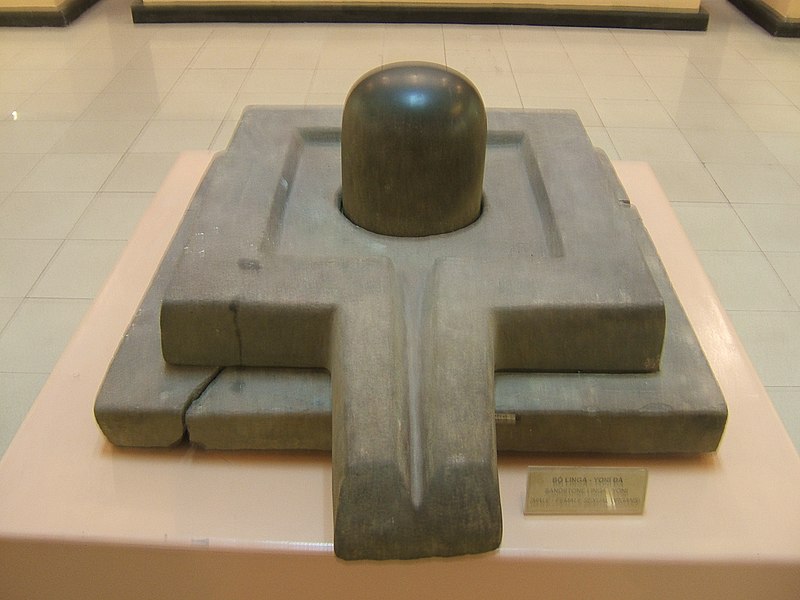 |
| Linga-Yoni at the Cát Tiên sanctuary, Lâm Đồng province, Vietnam |
To the indigenous Việt cosmology, the vault of heaven is encircles the earth. Hence bánh dày | mochi in the round. (I said, "She was more like a beauty queen from a movie screen. Dont mind but what do you mean I am the one Who will dance on the floor in the round?")
 Aside: bánh tét is a related dish which was purportedly derived during the Nam tiến | the Southern expansion period (17th C VN's version of Manifest Destiny conquest). It can have the same savory ingredients as Bánh Chưng or alternately contain a sweet mixture of sticky rice & banana. Significantly enough the Southern region in VN retains more Indic cultural influence via the conquest of Cham & Khmer kingdoms (and more Sinic influence via the Ming dynasty refugees who settled the area). It is unsurprising that the cylindrical shape should therefore represent the linga, completing the cosmic dialectic. (Oh, and thanks internet for showing me that I am not the only one to make this connection so you can stop looking at me like I am prurient, all you Việt Kiều.)
 |
| biggest Linga and Yoni in Southeast Asia |
I have been wanting to make Bánh Chưng ever since I became a mother to continue the tradition; and once my grandparents' passed, as a part of their legacy, but life got in the way and I was daunted. This year with my ascending energy, I gave it a go though it was a few weeks after Tết. I kinda winged it, loosely referring to some instructions I wrote down from my mom and Bach Ngo's cookbook, using what ingredients I had: pork belly instead of shoulder (too fatty, not enough meat), no shallots (hard to source organic ones). I didn't hull the mung beans because it just seemed like a lot of work and anyway it's just more fiber; I didn't precook them either because of the time and not wanting to cook all the nutrients out. I struggled with wrapping (darn banana leaves kept splitting when I was wrapping it and my corners were not tight so there was some water that got in). Then I posted my results on Facebook and got lots of feedback from my aunty Len and my mama (who I let weigh in this post with her advice). I suggest looking up youtube tutorials on wrapping as I haven't mastered this. The one drawback is the ones from Việt Nam use fresh banana leaves that have a different texture & length than the ones we can source here. Frozen banana leaves can be found in an Asian or Latino market (especially the Caribbean ones) and occasionally I've seen fresh banana leaves.
Bánh Chưng
makes three 9x9 inch "cakes"- 10 cups of organic, sprouted glutinous brown rice (alternately called sticky rice, sweet rice, mochi rice)
- 1 lb organic sprouted mung beans
- banana leaves washed & dried and then blanched
- optional 8 shallots
- 1/4 c. Red Boat fish sauce
- Celtic or grey salt
- 1/5 tsp freshly ground black pepper
- 2-1/2 lbs of sustainably raised pork shoulder or ham, cut into 2 inch cubes
- coconut palm sugar
- optional coconut milk (full fat kind, not the dairy alternative kind)
- cotton kitchen twine
- 24 qt stockpot or pressure cooker
- Bragg's amino acids or Coconut secret amino acids
- lard or coconut oil
RICE RICE BABY
Soak rice & mung beans separately overnight in filtered water. Drain the water separately (can be composted). You may proceed with the recipe from this step or to boost the nutritional value, sprout the grains by and rinse 1-2 times a day for 2-3 days until the germ sprouts a little tail.Pulverize shallots, fish sauce, salt & pepper in a food processor, mortar & pestle or with a hand blender. Add to the pork and marinade for several hours or overnight.
If you do plan on cooking the mung beans, boil them for 10 minutes.
Mama Says:
cook bean , add salt while cook, add sugar after cook, smashed the cooked bean, add little coconut milk, form to the same size of banh chung, 1" thick, if you want savory, add fried onion, pepper.
cook sweet rice halfway in batch with salt, this way easy to roll.I didn't bother seasoning the beans or parboiling the rice. Extra steps but my result was plainer so I'd add shallots, more fish sauce & salt next time.
REFUGEE EDUCATION #1 Ba-Na-Na
Wash and dry banana leaves. The frozen kind are softer than the fresh kind. According to my mama: "Deep [dip] banana leave in the boiled water To soften it and also sterile the leave, dry the leave both side with paper towel." [2/1/2015 note: Mom also says use banana leaves from Thailand, not the Philippines and to cut off the rib for pliability.]A traditional khuôn | mold for Bánh Chưng is a square frame with a an interior box like a springform pan. You can use a 9x9 baking dish as the mold as I did, make a wood one, or DIY one from cardboard as my mama does.
Mama says:
use the cardboard cut a long strip and make it to square box, tape it at the one corner to make the mold,1st layer one piece of leave 15" long, 2nd layer 4 pieces of leave center overlap on top the 1st layer, the outside of leave it outside . put the square box on top of the leave not straight side (xeo xeo) tear two strips of banana leave, the width same size of one side of the box, put banana strip crisscross inside the square box, put cooked rice on top the banana strip, pat the rice to make it solid at the base, put cooked bean & meat or what ever!!!,top with another layer of cooked rice pat it down. fold the banana strips to make the square, pull the cardboard out now you already have one small square banh chung, now just fold the outside banana leave, just like gift wrap. tight with string. cook with boiled water for 2.5 hrs it done.I boiled in a pressure cooker for 3 hours since brown glutinous rice takes longer to cook than white glutinous rice. Since my pressure cooker is small, I could only fit 1 Bánh Chưng at a time so this was a 3 day cooking process! (Still not as bad as the time I decided to make a 10-course dinner for my 30th birthday which entailed a 5 page workplan, a week of prep, 10 lbs of pork, and 3 or 4 days of cooking and borrowing a friend's oven for the second roast. Oh and kalua pork juices charred in the ovens, the nước mấm spilled all over my then-boyfriend, now husband's car causing him to ban kalua pork and fish sauce for a while. I of course got drunk in relief and exhaustion at the party and ate not much of it. I don't do such crazy things no more.)
 |
| Fried. Obviously too hungry to do pretty staging & lighting. |
Cooked Bánh Chưng can be frozen and resteamed. Leave it in its banana glory and slip into a freezer bag.
Tutorials on wrapping and molds: