Monday, April 7, 2014

Ancestral Foodways: My way

I was honored to be invited by my inimitable friend Loan to give a short talk today on the topic of Food & Culture to her Asian American studies class at the U Mass, Boston through the magic of the internet and the Borg technology of google. This is the talk I gave with additional links and visuals.

Ancestral Foodways: My way

It's such a beautiful thing, this musical thing
When I can do it my way and shootin' no blanks
I just refute what you think, a quite unusual thing
Yes it's a mutual thing 'cos it's the root of all things and we aims to be
Blackalicious feat. Lyrics Born "Do This My Way"

My name is Leilani.  I am Vietnamese American mother, childbirth educator & matrescence doula, and writer.  There’s a lot of other things I do and am but that covers the main points.  I’ll be talking to you today about my blog Real Food, Real Pho and why I write it.

MY BACKGROUND

My ma, aunty, big bro & sis, and me

I’m a second/third generation refugee.  My maternal grandparents became refugees for the first time in 1954 leaving North Vietnam to settle in the Central region.  My entire maternal side grandparents, aunties, uncles were sponsored as refugees in April 1975 by my eldest aunty who was married to a US serviceman and living in Honolulu.  My mom was 8 mos pregnant with me at the time.  I was born a few weeks later and we lived there for several years.  My mom owned a mauna pua truck selling siau pau (pork buns), ice cream and candy; nowadays it’s what would be called a food truck and it would be trendy, but back then, it was grey market (not strictly legal) and the city eventually shut them down.

My phamily eventually resettled in San Diego in the 80s because there was not a lot of work in Hawai'i.  It's not paradise when you don't have prospects.  My mom was a single working mom.  We were on food stamps for a number of years.  This was before there were any Vietnamese grocery stores so we ate a lot of american processed food because that is what you could get with food stamps--velveeta, powdered milk, processed food stuff (which means food altered in factories which destroys nutrients, especially the “whites"--white rice, white flour, white sugar).  Even when there was fresh Vietnamese produce and ingredients to be had, american processed food became a regular part of our diet because single mom + three kids = not a lot of time to cook.  We wanted to be like other kids and eat McDonald’s, spaghetti, pizza, soda.  My mom’s cooking too was very fusion which is probably influenced by living in Hawai’i where there is a meld of culture and cuisines; we ate lettuce and greens in our spaghetti.

Eating roasted rice paddy mice
 in the Mekong Delta 2007
f sustainable free range
pasture-raised

When I went to college, I double majored in Anthropology and Linguistics and this is when I first started cooking for myself. I later went on to an intensive doctoral program in Anthropology where I focused on the culture of emerging modern society in Vietnam at a time when the market was opening up from state-owned enterprise to more international capital.  As the years went by, I found myself focused more on community organizing where I lived and left academia to become a research analyst for almost a decade, serving grassroots organizations, indigenous groups all over the US, and for a low wage workers union.

For a long time, my philosophy in life was DIE for what I believe in, this was the value I inherited from my biological father, and it was killing me.  I burned out.  So I quit my job to be at home with my daughter and to learn how to LIVE for what I believe in.

NUTRITION & EPIGENETICS


A surprising fact is that most of the American population is malnourished and dehydrated in spite of eating so much, because of what they are eating (Standard American Diet or "SAD") is nutritionally empty and/or depletes nutrients.  I was no exception.  I was malnourished which is weird to think since I was not underweight or starving if anything I was thick, but there were signs through food cravings which are a way of one's body telling one that one is need something (example: a craving for carbs/pastries is a really a craving for shortterm energy because you don’t have enough reserves of the long term energy like healthy fat & protein), other signs were the vertical ridges in my teeth & nails, all the health issues I was experiencing, but going back to childhood and fetal development, even my tongue tie, my inherited overbite and lower teeth crowding was an indication of at least three generations of malnutrition.

This widespread phenomenon of malnutrition that comes from eating large quantities of "food" instead of malnutrition from the absence of food as in a famine or poverty, is recent in human history.  It's part of the industrialization of food production.  After centuries of extractive agricultural practices or chemical contamination, the soil is depleted of minerals and nutrients.  Food is being chemically altered if not genetically altered in factories. Vitamins and minerals that are destroyed in the processing are being added back synthetically in the form of vitamin fortification that is not bioavailable (easy for body to assimilate) and contributes to a toxic overload for our livers along with environmental toxins.  Processed food is essentially nutritionally empty.  We’re not taught much about real nutrition.  Popular culture references calories.  Calories are meaningless; it’s the nutrients that matter and where they come from matters most.

There’s this emerging branch of science now called epigenetics and it looks at how environment
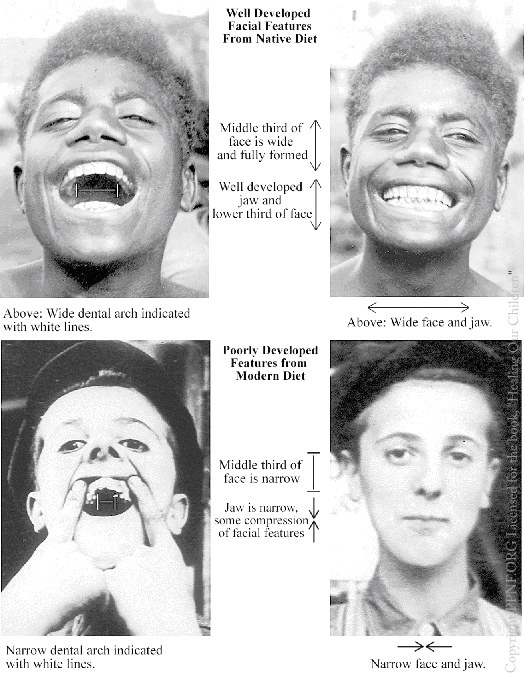
(toxins, nutrition or malnutrition) can alter the expression of your genes.  An example would be nutrition and dental formation.  There was a dentist named Weston Price  at the turn of the 20th century who noticed increasing problems with cavities and bite and connected it to the rise of industrially processed food like white flour and sugar.  He travelled all over the world and documented the introduction of processed food and its impact on dental health.  In families where they ate native foods, the children had robust facial structure, straight teeth, few to no dental issues.  In families where they ate processed foods, the children had smaller jaws, overbites/underbites, cavities.  In other words, humans are evolutionarily programmed to have straight teeth that can fit into their jawbones.  No animal species could survive if they didn’t have teeth that were functional.  Dr. Price understood that nutrition was critical in bone formation and to optimal health.  He developed a philosophy that can be paraphrased as “eating what your ancestors ate”.  Nowadays, we have the understanding to say the malnutrition from processed foods affected the epigenetic expression of dental formation and it degenerates with each successive generation.
Stress and psychological trauma is also something that can be inherited behaviorally and epigenetically.  Stress affects the sympathetic system--the adrenal glands, hypothalamus, pituitary gland--which generates the fight, flight or freeze response.  Stress is also changes epigenetic expression and is passed on to the next generation in gene expression as well as behavior.  Scientists have done research on the children of survivors of Nazi death camps on behavioral inheritance of PTSD and more recently on the epigenetics of mice exposed to stress; stress/trauma affects the genes that are inherited by the next generation.  Your parents' experiences and reactions to stress predisposes your own sympathetic system and depletes or inhibits your body’s absorption of nutrients.  So my family history means that I have 150 years (+/-) of colonization and war trauma coded in my DNA.  It’s no surprise that my adrenals (adrenal glands make the master hormones that we need to survive) were worn out; so at my lowest, even though driving in traffic typically makes me anxious, I would experience near accidents and not feel anything.  This wasn’t a zen response.  I could feel a click like an ignition but nothing turned on.  My fight, flight or freeze reaction was not happening.  I didn’t get the burst of adrenaline to help me react to a situation and keep myself safe because my adrenals were not functioning.

BURNOUT TO BALANCE


So I burned out.  I had developed systemic, auto-immune issues, that’s when your body becomes so stressed out it attacks itself--for example, allergies, skin issues, diabetes, in extreme cases, cancer.  My adrenals just about shut down,  and I was pretty close to being bedridden.  I had barely out enough energy to drag myself out of bed and sludge through my day.  You ever watch Shaun of the Dead?  It was the first zombie romantic comedy.  The opening montage (minus the peppy music)?  The working dead.  That's what it felt like.  Life was flat.  All the ailments I had were beyond the scope of Western medicine to heal; Western medicine is about masking the symptoms, not getting to the root causes.  I had to heal myself.  And I did.  A huge part of that healing process is FOOD.  Food is my medicine. (I believe medicine is anything that heals your body, mind, and spirit/soul; this can be music, talk story, wisdom, plants, love, spiritual/ancestral connection, and food among others.)

I considered myself a healthy eater up to that point.  We ate mostly homemade cooking with a lot of white rice, fresh vegetables and meat at every meal, some processed food everyday; processed food is anything that did not recently come from the earth or an animal.  We didn’t eat too differently from the way we were raised, lots of stir-fries.  But the lifetime of stress, inherited stress from war/refugee trauma in prior generations, coffee/sugar dependence, and processed foods (donuts!) had depleted my body, weakened my organs & systems.

Something had to change and that something was ME.  No one else could tell me how/why.  I was my own personal health investigator.  Over the last 5 years, I tried a lot of holistic alternative medicine like naturopath, chiropractor, muscle testing, acupuncture, osteopath, yoga, breathwork & meditation, read a lot of articles and blogs, reset my circadian rhythm, and those all contributed, but food and more specifically nutrition is where I experienced the most changes.

Instead of popping a multi-vitamin (which I had “allergic” rash reactions to but were really my liver being overloaded with toxins and passing into the blood stream triggering an histamine immune reaction), I had to replenish my nutrients from eating whole, real foods--food that recently came from the earth and from animals, not from a factory or a lab.

homemade dưa chua
pickled mustard greens
I started off eliminating wheat and dairy, and my seasonal allergies went away.  I went organic and my skin, digestion, and hormones improved.  I gave up alcohol, coffee and caffeine (oh this was hard, no more cà phê sữa đá!) and the migraines and vertigo stopped.  I added healthy fats and my brain function and memory came back.  I eliminated sugar and reduced grains, added more veggies, green smoothies, and my blood sugar stabilized and I lost a little weight and girth (really it's volume from inflammation more than weight).  I drank more water spiked with sea salt, and my skin improved and I could sleep at night without waking up from hormonal surges feeling hot, dry & hungry.  I eliminated additives like MSG or preservatives that are neuro-toxic and my mood stabilized, my stress/anxiety levels normalized, the agitation & anger/irritability reduced and sleeping regularized.  I added homemade fermented foods dense with natural probiotics like sauerkraut, pickled mustard greens, and the ridges in my nails have smoothed out.  I stopped eating processed foods, I even gave up supposedly healthy organic processed foods, the organic blue tortilla chips, the organic gluten-free breads because they were just organic empty calories; I gave up most restaurant food because of the sugar and additives.  There’s the saying you are what you eat.  When I eat processed foods, conventionally grown meat, I get sick.
Local sustainably caught
Chinook salmon

Overall, my body was less inflammed which I can quantify by looking at my white blood count which used to be through the roof and are now in the low end of normal.  Along with the loving support of my family, yoga and deep breathing (which not only changes your brainwaves, but also affects epigenetic expression!), my creativity is re-emerging, and I feel whole again.

THE SOUL OF VINAMESE FOODWAYS: MY WAY


real phở

When I eliminated wheat and dairy, I thought well, I’ll keep it easy and cook Vietnamese/Asian food following the food philosophy of "Eat what your ancestors ate" because my ancestors were not eating macaroni & cheese from a box.  And you think of Asian food and you think of rice, not wheat.  And then as I started reading the labels, I realized how much processing goes into Vietnamese food--not just MSG, but MSG in all its iterations (hydrolyzed wheat protein, "natural flavor", soy protein, etc), wheat derivatives, refined sugar, preservatives (not just banned formaldehyde, but FDA approved preservatives), food coloring.  This is not how my ancestors ate.  So I had to find ingredients that didn’t contain additives, wheat, dairy, refined sugar, minimally processed.  I had to decolonize my diet.


xôi gấc—red sticky rice in a 
traditional Lao steaming pot
I had to learn how to truly make food from scratch using ancestral foodways that maximize nutrition instead of shortcuts that comes from modern living always being in a hurry and on the go, that can be counter-nutritive.  I couldn’t find a single source for recipes/blogs that made Vietnamese food using whole ingredients and ancestral foodways.  Some ancestral foodways I saw my grandparents practice, other things I pieced together from blogs about homesteading or whole foods cooking.  So that’s when I started blogging, to reclaim and sometimes remake ancestral food ways.  


Sprouted brown rice
I’ll take as an example, rice.  I went from eating white jasmine rice every day 1-2 times a day to eating brown rice, then organic brown rice every day to now eating organic brown rice maybe 2-3 times a week and soaking and sprouting the rice 2-3 days to reduce the anti-nutrients like phytic acid which are inherent in all seeds and to leach out the arsenic from soil contamination that is endemic to all arable land all over the world; seeds contain all the genetic information for new life, so they have innate self-defense in the form of anti-nutrients like phytic acid.  Sprouting changes the rice from a seed to a plant and releasing its nutritional value.  Sprouting is an ancestral foodway that has been lost in the translation/export of food.  I could go on about the globalization and misappropriation of "super foods" and the sometimes fatal stripping of foodways and cultural context but I’ll leave it there.  (My blog post on corn gets into this a bit.)

Growing native corn
I am not a professionally trained chef.  Like most home cooks, I came to cooking as a necessity when I started living on my own in college. I learned by calling my mom on the phone, reading cookbooks, recipes and blogs, through tips from friends and strangers, learned through making mistakes.  I cook for my family, I cook for me, for my community of friends.  For me, it started with phở which I grew up eating at family gatherings every Sunday. But I've experimented with all kinds of cuisines from American to Moroccan to Irish.  I've rendered lard, made corned beef by fermenting organic grass-fed beef over a week; I've made pozole by growing, harvesting and nixtamalizing maize (which is a process of alkalizing the kernels to release the nutrients similar to hominy) and stewing an entire hog's head (which is a very gnarly experience.  The snout!  The teeth! The eyeballs!).  Somethings I've made better than others.  A lot of things I've botched.  But more than expertise I’ve found what matters is the ingredients.  Real food, sustainably grown, tastes better and is more nourishing.  It can be costly, but there are frugal strategies, like growing your own vegetables, joining buying coops and buying straight from the farmer (called Community Supported Agriculture).  Organic, grass-feed beef which can cost up to $25/lb at the store, costs $5/lb buying a sustainably-raised whole steer from a local farmer, and then paying the butcher.  It's more expensive than conventionally raised cows, but I don't get boils from the antibiotics and growth hormones that they feed them (not to mention the stress hormones from their living conditions and manner of slaughter). It’s a damn sight cheaper than the thousands of dollars I was spending on health care, supplements, and short term fixes.

MY SOUL FOOD


The soul of my cooking is a love of food and family.  For me, cooking Vietnamese food is the way I remember my grandparents who were self-sufficient, subsistence farmers before the wars and who transplanted here to the US, had a subsistence garden no matter where they lived in the hood and carried on foodways and traditions of cooking from their upbringing.  Cooking is how I honor their legacy, and make it meaningful and present for my daughter. There is a story in each meal, a rich history in the making of it, and quality in the eating of it. Taking the time to make something from scratch using ancestral food ways infuses the food with more flavor, more nutrients, more tradition, and more love.

Vietnamese culture is some 4000 years old give or take.  The cuisine is inflected with the rich cultural and historical influences from several millenia of globalization.  The native palate (fish sauce, hot/sour/salty/sweet), Melanesia/Polynesia from antiquity, over two millenia of influence from countries of that are now called India & China, from the conquest and absorption of the Khmer and Champa kingdoms 400 years ago, Portuguese missionizing 16th c-18th c, and then, the less than 150 years of influence from French colonization, a blip of less than 2 decades of American war, more recently aspirations for japanese/korean modernity.

Conventional Bánh da lợn |Pigskin cake
made with white sugar, food coloring
& flavor extract
My Bánh da lợn| PIgskin cake
Made without additives
Food is constantly evolving.  I don’t claim to cook authentic as it was made 100 years ago by my great grandmother. There were adapted foodways that my grandparents practiced that I eschew like food coloring, karo corn syrup or white rice flour in favor of more nutritious practices.  The results are not like we are now used to eating; the appearance, colors, taste, texture are wildly different. And, I live here in the US, this is my context.  I have a food processor and I use it.  I eat kale with everything even my phở.  I have a family to feed and I don’t always have all day to cook so I do make shortcuts, but I try not to compromise on nutrition.  It’s been a learning process for me to challenge myself where I feel daunted (Bánh Chưng! hog’s head!) and to reinvent.  So this blog is my take on ancestral food ways and LIVING for what I believe in.

From the rooter to the tooter--hog's head broth

It's such a beautiful thing, this musical thing
When I can do it my way
Ain't shootin' no blanks
I just refute what you think
A quite unusual thing, Yes it's a mutual thing
Cos it's the root of all things, and we end.


Q &A from the class (paraphrased)

What is organic? 

Organic is a certification that the food is sustainably raised without the use of toxic chemicals like pesticides, herbicides, and is not genetically modified.  http://www.organicconsumers.org 

Do you use measurements? 

I tend to be a freehand, improvisational cook, even when I am using a recipe.  I eyeball it.  The way I learned from my mom was "use a rice bowl (or handful) full of ..."  or "put as much as you like" so it's very relative.  That also means, sometimes my results are not consistent especially with a new recipe.  But then I also have interesting surprises because I don't stick to recipes, even when I use someone else's recipe.  I do try to use measurements for most of my recipes that I share with folks. 

Are nutrient supplements or vitamins bad for you? 

There are two kinds of vitamins--synthetic and food-based.  The synthetic kind are made in a laboratory from who knows what kind of material; it's not as bio-available and usually you see/smell the excess sloughed off in your waste (i.e. that weird urine color/smell).  Food-based vitamins are extracted from real food in a laboratory.  They are better (and more expensive) than synthetic chemicals.  But the best way to get nutrients is from eating real food.  It's like taking bromelain as an anti-inflammatory supplement when you can eat just eat a pineapple instead.  But if you have to choose a vitamin, choose the food-based one.   
4/8/2014 Another thing about vitamins... medicinal herbs are another great way to get vitamins and minerals that are bioavailable and inexpensive.  Dandelion for example (not a weed, but medicine!) is a good source of iron, calcium and potassium and it supports liver function. Dandelions can be eaten (cooked), taken as a infusion/tea, or made into a tincture with brandy.  I take it ever take this whenever I need liver support in flushing out excess toxins because it helps to support the liver. Also it makes a good post-drinking tonic.  Just saying'.  Nettle is another good one that supports the kidneys/adrenals, is great for allergies (seasonal and other) by helping to flush the histamines, and is a milks analgesic (pain relief).  It has Vitamins A, C, D, K, calcium, phosphorus, iron, sulphur.  You can generally find medicinal herbs at a natural food store or online in bulk or in tea packets.  Try to source it organic.  You could also go out to a meadow where you are reasonably sure they do not spray herbicides and harvest it there (this is called wildcrafting or foraging).
Green smoothies are a great way to increase your vegetable intake and boost your vitamin/mineral intake.  I have one for breakfast every day (chia seed, coconut flakes, flax seed, carrot, cucumber, cooked spinach or kale, blueberries, pineapple, a pinch of sea salt, and sometimes ginger powder,).  I cook my leafy greens because of the oxalic acid and other anti-nutrients/goitrogen in raw greens.

Ăn Ngon Lành|Eat Delectably!

For resources and further reading, check out the resources section in my FAQs.


Have more questions or comments?  I'd love to hear from you.  Hit me up below or email me realfoodrealpho @ gmail.com.

Sunday, April 6, 2014

Lemongrass Meat marinade


This is a basic marinade for roasted/grilled/broiled meats requested by my sister.  She also made a great suggestion of adding oil to the marinade.  This helps the meat to be a little crispier on the outside and retain moisture while cooking.

Ingredients:

  • Lemongrass
  • Red Boat fish sauce
  • palm sugar or coconut palm sugar*
  • celtic salt (gray salt)
  • garlic
  • oil (EV olive oil, coconut oil, or pasture-raised lard)


Chop of the top 1/3 or lemongrass stalk.  Using the unsharpened side of a chopping knife, bruise the lemongrass all along its length to release the juices.

Add everything to a food processor and pulverize.  Put meat in a bowl, pot or freezer bag and add marinade.  Toss until coated, then allow to marinade for a few hours in the fridge.

Cook meat in your favorite way (grill or broil).  Can be eaten with brown rice or noodles/spring rolls or on salad.

*For those who are eating paleo or sugar-free, you can substitute syrup made from 1/2 c hot water and 1/3 cup dates, apricots or prunes & 1/4 tsp lemon juice.  The syrup will keep for 1 week in the fridge.


Ăn Ngon Lành|Eat Delectably!

Tuesday, April 1, 2014

bánh dầy | brown rice mochichi recipe

Mochichi mochichi.  Four ways to eat mochi.

After my previous recipe test, I've been tweaking the macrobiotic brown rice mochi recipe by Jill Ettinger (Organic Authority) and I've compared to a couple of Việt bánh dầy recipes.

My mochi recipe has a lot of variations from savory to sweet applications: steamed, baked, boiled in ginger syrup with mung bean filling (Chè trôi nước), or fried with mung bean filling (bánh cam|orange mochi).  


Steamed and/or baked can be eaten with chả lụa|silky pork sausage. We make do with deli meat for now until I get this year's pork share and give chả lụa making a go. 

Steamed is gooey goodness.  Baked is crispy on the outside, gooey on the inside.

Chè trôi nước is part of the traditional offering to ancestors & deities on birthdays, death anniversaries, and lunar sacred days (Tết Nguyên Đán|Lunar New Year, Tết Trung Thu|Mid-Autumn Moon Festival); Mẹ rể|my mother-in-law introduced me to this.  

Bánh cam is one of my favorite treats.  Bà ngoại|my maternal grandmother used to make these for the grandchildren.


Bánh Dầy|brown rice mochichi recipe

Makes 12

Mochi Dough:

sprouted brown rice
  • 2 c. organic sweet brown rice
  • filtered water to soak
  • 1 tsp celtic/grey sea salt
  • 1/2 c. water
For steamed mochi: 
  • parchment paper or banana leaves cut into 3.5 inch squares 
  • pasture-raised lard or coconut oil 
For baked mochi: 
  • parchment paper to cover a baking sheet
  • tapioca starch or ground dry brown rice
For Chè trôi nước:
  • water
  • grated or thinly sliced ginger
  • organic coconut palm sugar or fruit syrup*
  • 1 cup sprouted organic mung beans
  • optional shallots if you like it savory
For Bánh cam:
  • organic coconut palm sugar or dried apricots
  • 1 cup sprouted organic mung beans
  • optional shallots if you like it savory
  • organic unhulled raw sesame seeds
  • coconut oil for frying
Equipment: 1 quart mason jar, sprout lid (optional), food processor, 2 oz cookie scoop, scraper and pyrex containers, pressure cooker or pot with a steam rack, baking sheet, deep fryer.


SPROUTING:

[1/13/2015 I no longer sprout sweet rice because I find the flavor is more pungent/cloying. I soak overnight with bincho-tan.Sprout the rice grains (to a notch is fine) and, if you are trying the latter two recipes, sprout the mung beans too in order to reduce anti-nutrients (phytic acid and arsenic).  This can take 1.5-2 days.  Since my daughter is starting extended hours at school on Monday and I need to get lunch together, I started on Friday.  The method I used is to soak the rice and mung beans separately overnight in mason jar with filtered water and a chunk of bincho-tan. Cover jar with a sprout lid (can use a towel).  The next day when I noticed the grains had expanded and almost filled the quart jar, I drained it and let it sit damp for several hours or until the next day until I see a sprout on the germ of the grains.  I probably could have done this Saturday evening, but I did it in the morning instead.  Grains should be rinsed at least once daily with filtered water.  Can take 2-3 days to sprout.  Discard the water.  I personally don't use the rice water for compost/gardening because of the arsenic runoff.  The mung bean water can be grey water recycled.


MOCHI DOUGH:

Pour the grains into the food processor along with 1 tsp of grey sea salt.  Turn it on and slowly add the water until the dough forms.   Remove blades and let the dough sit for 1 hour for the moisture to absorb; this will help ensure the right texture.  When I don't let the dough rest, the texture is grainier like smashed up sticky rice.


steampunk mochi dough

STEAMPUNK MOCHI

Put enough water for steaming into the pressure cooker or steam pot and bring the water up to a boil.  

While that is going on, lightly grease a cookie scoop with lard or coconut oil.  Scoop out a ball of dough and put on a square of parchment paper.  Re-grease the cookie scoop between scoops. Rice cake balls can be nestled next to each other as long as there is parchment paper between them.


Steam in a pressure cooker for 10 minutes or 30 minutes in a steamer pot.


mochi beignet

STEAMED & BAKED MOCHI

Turn your oven to 450 degrees Fahrenheit.  Put a parchment paper on a baking sheet and dust tapioca starch or rice powder.

Coat your hands with tapioca starch or rice powder and make 1-1.5 inch balls.  Flatten them into thick patties approximately 2 inches across. 

Steam in a pressure cooker for 10 minutes or 30 minutes in a steamer pot.


Remove then place on baking sheet with space between for expansion.  Bake for 10 minutes.


CHÈ TRÔI NỨOC

Filling: While the batter is hydrating, cook the mung beans in water with a pinch of salt for 10 minutes. Drain.  Smash the beans and add sugar to taste.  Roll them into 1 to 1.5 inch balls.


Mochi in the Middle
Offering for Lễ Thôi Nôi | 1 Lunar Month Baby celebration
Ginger syrup: In a pot add 4-6 cups of water, ginger slivers, and coconut palm sugar.  Bring to a low boil, then reduce to a simmer.

Mochi: Wet your hands.  Roll 2 to 3 inch balls and flatten them to about 1/8 to 1/4 inch thick.  You may need to add more water to the dough to make it more elastic.  Put a ball of mung beans in the center and seal the dough around it.  It doesn't have to be a tight fit.  Set aside on a plate or baking sheet.  When you run out of filling, roll the remaining dough into little balls of a half inch or less.  They'll be like little gooey pearls.

When you have made all the balls, add them to the ginger syrup and bring to a low boil for 5 minutes.  Serve hot.


BÁNH CAM

Filling: While the batter is hydrating, cook the mung beans in water with a pinch of salt for 10 minutes. Drain.  Smash the beans and add sugar to taste.

Mochi: Wet your hands.  Roll 2 to 3 inch balls and flatten them to about 1/8 to 1/4 inch thick.  You may need to add more water to the dough to make it more elastic.  Put a ball of mung beans in the center and seal the dough around it.  It doesn't have to be a tight fit.  Roll in the sesame seeds.  


Fill a deep fryer or a pot with coconut oil and turn on medium high.  drop in some of the mochi pearls to test temperature.  Fry the mochi in batches until deep golden (whence the name orange cake).  Scoop out and cool on a napkin-lined plate.  Eat when cooled to a bearable temperature.


* * * * * * *
So many ways to eat mochi...

munching on mochi

Mochichichi Mochichi.
Oh so Soft and Cuddly!
Happy, happy Mochichi.
I love you, Mochichi!


Ăn Ngon Lành|Eat Delectably!

*I've recently watched Dr. Robert Lustig's TEDx talk where he lists the 56 names of sugar.  While coconut palm sugar was not one of the named and has a lower glycemic index, it still is a refined sugar though a better choice than cane sugar.  For a no refined sugar approach, I suggest a fruit syrup.

Monday, March 31, 2014

Cà-Ri Gà | Curry Chicken


If you're not focused on the most important stuff, and all that you've got left to show, is Curry Curry on the go


This dish is a melange of cultural & agricultural influence centuries of globalization from fish sauce indigenous to Viet cooking, coconut milk from Pacific currents at least 55 million years ago, lemongrass and curry spices from India (at least 1st century AD), potatoes from the New World (via 16th century Ming Dynasty China), and baguettes via colonial France (18th Century).  


This was one of my favorite meals growing up (and the first meal I learned to cook as an independent young adult).  The pot of curry would be set in the middle of the table and we'd ladle a bowl full and sop it up with baguettes.  The turmeric would stain our hands and once, memorably, my cousine Jacqui's toothbrush.  


The first time I saw this eaten with rice was when I had lunch at the UCSD Dining Commons with my sister Uyên's freshman year of college.  I was horrified, if you can imagine.  It was very outside of my insular world view at the time.  


Now that I no longer eat wheat, rice & curry has become unremarkable.


As always I like to boost the nutritional value.  I favor yams, sweet potatoes, taro, or cassava over potatoes and leafy greens like kale, collards, or chard.  (Just be sure to wear gloves while peeling taro as it can irritate the skin.)  Mostly I use sweet potatoes because they are easier to source organic and leave off the carrots so it won't be too sweet.  You can also use any squash like acorn, butternut, zucchini, kabocha, etc.


I'll give you a foxtrot--two ways to make this quick-quick & slow.

Cà-Ri Gà | Curry Chicken

  • 6 organic chicken leg quarters (or whole chicken chopped into small chunks), unwashed (or meat of choice)
  • 3-5 organic sweet potatoes scrubbed, peeled and cut into chunks
  • coconut milk* (not the dairy alternative kind)
  • optional carrots
  • kale, chopped
  • sweet onion
  • Madras Curry powder (mild yellow curry)
  • lemongrass, bruised
  • Red Boat fish sauce
  • Celtic or grey salt
  • Coconut milk (look for an additive-free brand like Butterfly or frozen)
  • 6 qt stock pot (I have a lovely La Cocotte Dutch Oven that I just  got on clearance at Home goods in February)
  • baguettes or brown rice


Quick-Quick 

~30 min
Put chicken legs into the stock pot, 3 tbs of Madras curry or more according to taste, fish sauce, handful of grey salt, cover with water and lid.  Bring to a low boil for 15 minutes.  

While it's heating up, chop onions into quarters & prep the root vegetables.  Add the lemongrass, onion & root vegetables to the pot as you go.  

Using the dull side of a clean cleaver or knife, bruise the lemongrass all along the stalk to release the juices.  Chop into half and add to pot.  

When the 15 minutes are up, add chopped kale and cover with lid again until cooked.  Turn off heat, add coconut milk, stir well and serve. Add fish sauce or salt to taste.

Slow

If you are feeling industrious, you can chop the chicken into chunks.  Exposing the marrow greatly increases the flavor.   Marinade the chicken or meat with 2 tbs curry powder and sea salt for 2 hours or overnight.  

Put the sweet onion, skin and all, into the oven or toaster oven.  Broil whole for 15 minutes or until cooked through.

Add chicken to the stock pot, 1-2 tbs of Madras curry or more according to taste, fish sauce, handful of grey salt, cover with water and lid.  Bring to a low boil for 15-20 minutes.  

While it's heating up, prep lemongrass & root vegetables.  

Bouquet garnis of lemongrass: Tear off one leaf and set aside.  Using the dull side of a clean cleaver or knife, bruise the lemongrass all along the stalk to release the juices.  Fold it up into thirds, tie with the spare leaf, and add to pot.  

When onion is nicely caramelized, add it to the pot char and all.

Chop the root vegetables and add to the pot.

When the chicken is cooked, add chopped kale and cover with lid again until tender.  Turn off heat, add coconut milk, stir well and serve.  Add fish sauce or salt to taste.


* * * * * *

Serve curry over rice or with warm baguettes.  The rare occasions that I eat GF bread, I use Pamela's pizza crust mix.  The processed carbs or perhaps the binder/thickener cause me a little digestive upset (irritability, spike in blood sugar and then acceleration of hunger) so I try not to eat this very often.

Best served while watching this clip from the original Japanese movie Shall We Dance?

Ăn Ngon Lành|Eat Delectably!

*Tropical Traditions recipe for making your own coconut milk here.  If you are using frozen,give the package a quick rinse before opening to remove any residue, dirt, etc.

Saturday, March 1, 2014

Bánh Chưng | Earth cake for Lunar New Year

Bánh Chưng is a traditional Việt dish for Tết | the Lunar New Year.  Back in the nascent days of Việt Nam's tribal past, legend has it that after defeating the Shang dynasty incursion, the 6th Hùng Vương king (ca. 2300 BC) decided to choose his successor among his sons by a cooking contest; yes, a prehistoric Top Chef competition with the winner being crowned king.  Primogeniture had no valency in pre-Sinic Van Lang; patrilineal confucianism came later.  The winningest son who was 18th in birth order and poor to boot was visited by a nữ tiên | a goddess who advised him to use the simple ingredients of the people, wrap it in banana leaves and boil it.  So he chose gạo nếp | glutinous rice, đậu xanh | mung beans, and pork, shaped it vuông vuông | square creating Bánh Chưng which in ancient Việt cosmology represents the earth.  He also made bánh dày | mochi in the round to represent Heaven.  I know that seems puzzling to imagine the earth as square and Heaven round.


Flying over north VN
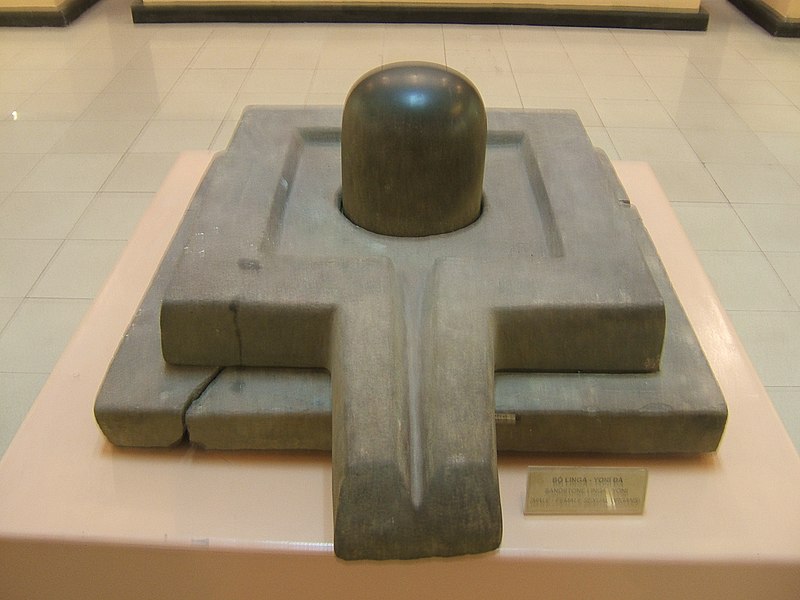
Bear with me here as I diverge through my anti-halcyon grad school years.  I took a seminar on the Sacred Feminine in Southeast Asia with Dr. Ashley Thompson who kept emphasizing that there were Indic yonis & lingam all over Southeast Asia including VN which utterly befuddled me at the time (how is a square pedestal a yoni?).  And I finally puzzled out the connection between cosmic geometry and everyday objects; on the geographic level, a rice paddy is roughly square in shape when on level land, a metonymic connection to earth; on the symbolic/metaphoric level, a square set on its corner, is a diamond or rhombus, the universal symbol of the yoni.  Now, thanks to Ashley and the Sacred Feminine (sounds like a great band name) my secret sixth sense to wit is: (sigh) I. See. Yonis. Everywhere. (I'm talking about you, Crystal Vulva Cathedral) which is a damn sight better than seeing lingam everywhere let me tell you.
Linga-Yoni at the Cát Tiên sanctuary,
Lâm Đồng province, Vietnam

To the indigenous Việt cosmology, the vault of heaven is encircles the earth.  Hence  bánh dày | mochi in the round.  (I said, "She was more like a beauty queen from a movie screen.  Dont mind but what do you mean I am the one Who will dance on the floor in the round?")
Aside: bántét is a related dish which was purportedly derived during the Nam tiến | the Southern expansion period (17th C VN's version of Manifest Destiny conquest).  It can have the same savory ingredients as Bánh Chưng or alternately contain a sweet mixture of sticky rice & banana.  Significantly enough the Southern region in VN retains more Indic cultural influence via the conquest of Cham & Khmer kingdoms (and more Sinic influence via the Ming dynasty refugees who settled the area).  It is unsurprising that the cylindrical shape should therefore represent the linga, completing the cosmic dialectic.  (Oh, and thanks internet for showing me that I am not the only one to make this connection so you can stop looking at me like I am prurient, all you Việt Kiều.)

biggest Linga and Yoni in Southeast Asia
During my childhood, Ông Bà Ngoại |my maternal grandparents and Ông ngoai in particular would make dozens and dozens of Bánh Chưng the week before Tết.  Ông Ngoại would set the banana leaves in a frame and skillfully wrap dozens of Bánh Chưng (Ohio St, Auburn Dr, 54th).  Then he'd light a small bonfire in the backyard and boil them in a clean galvanized steel trash can.  The cooked Bánh Chưng would be distributed among the Phamily and the community.


I have been wanting to make Bánh Chưng ever since I became a mother to continue the tradition; and once my grandparents' passed, as a part of their legacy, but life got in the way and I was daunted.  This year with my ascending energy, I gave it a go though it was a few weeks after Tết.  I kinda winged it, loosely referring to some instructions I wrote down from my mom and Bach Ngo's cookbook, using what ingredients I had: pork belly instead of shoulder (too fatty, not enough meat), no shallots (hard to source organic ones).  I didn't hull the mung beans because it just seemed like a lot of work and anyway it's just more fiber; I didn't precook them either because of the time and not wanting to cook all the nutrients out.  I struggled with wrapping (darn banana leaves kept splitting when I was wrapping it and my corners were not tight so there was some water that got in).  Then I posted my results on Facebook and got lots of feedback from my aunty Len and my mama (who I let weigh in this post with her advice).  I suggest looking up youtube tutorials on wrapping as I haven't mastered this.  The one drawback is the ones from Việt Nam use fresh banana leaves that have a different texture & length than the ones we can source here.  Frozen banana leaves can be found in an Asian or Latino market (especially the Caribbean ones) and occasionally I've seen fresh banana leaves.

Bánh Chưng

makes three 9x9 inch "cakes"
  • 10 cups of organic, sprouted glutinous brown rice (alternately called sticky rice, sweet rice, mochi rice)
  • 1 lb organic sprouted mung beans
  • banana leaves washed & dried and then blanched
  • optional 8 shallots
  • 1/4 c. Red Boat fish sauce
  • Celtic or grey salt
  • 1/5 tsp freshly ground black pepper
  • 2-1/2 lbs of sustainably raised pork shoulder or ham, cut into 2 inch cubes
  • coconut palm sugar
  • optional coconut milk (full fat kind, not the dairy alternative kind)
  • cotton kitchen twine
  • 24 qt stockpot or pressure cooker
  • Bragg's amino acids or Coconut secret amino acids
  • lard or coconut oil

RICE RICE BABY 

Soak rice & mung beans separately overnight in filtered water.  Drain the water separately (can be composted).  You may proceed with the recipe from this step or to boost the nutritional value, sprout the grains by  and rinse 1-2 times a day for 2-3 days until the germ sprouts a little tail.

Pulverize shallots, fish sauce, salt & pepper in a food processor, mortar & pestle or with a hand blender.  Add to the pork and marinade for several hours or overnight.


If you do plan on cooking the mung beans, boil them for 10 minutes.
Mama Says: 
cook bean , add salt while cook, add sugar after cook, smashed the cooked bean, add little coconut milk, form to the same size of banh chung, 1" thick, if you want savory, add fried onion, pepper. 
cook sweet rice halfway in batch with salt, this way easy to roll. 
I didn't bother seasoning the beans or parboiling the rice.  Extra steps but my result was plainer so I'd add shallots, more fish sauce & salt next time.


REFUGEE EDUCATION #1 Ba-Na-Na

Wash and dry banana leaves.  The frozen kind are softer than the fresh kind.  According to my mama: "Deep [dip] banana leave in the boiled water To soften it and also sterile the leave, dry the leave both side with paper towel." [2/1/2015 note: Mom also says use banana leaves from Thailand, not the Philippines and to cut off the rib for pliability.]

A traditional khuôn | mold for 
Bánh Chưng is a square frame with a an interior box like a springform pan.  You can use a 9x9 baking dish as the mold as I did, make a wood one, or DIY one from cardboard as my mama does.  
Mama says: 
use the cardboard cut a long strip and make it to square box, tape it at the one corner to make the mold,1st layer one piece of leave 15" long, 2nd layer 4 pieces of leave center overlap on top the 1st layer, the outside of leave it outside . put the square box on top of the leave not straight side (xeo xeo) tear two strips of banana leave, the width same size of one side of the box, put banana strip crisscross inside the square box, put cooked rice on top the banana strip, pat the rice to make it solid at the base, put cooked bean & meat or what ever!!!,top with another layer of cooked rice pat it down. fold the banana strips to make the square, pull the cardboard out now you already have one small square banh chung, now just fold the outside banana leave, just like gift wrap. tight with string. cook with boiled water for 2.5 hrs it done.
I boiled in a pressure cooker for 3 hours since brown glutinous rice takes longer to cook than white glutinous rice.  Since my pressure cooker is small, I could only fit 1 Bánh Chưng at a time so this was a 3 day cooking process!  (Still not as bad as the time I decided to make a 10-course dinner for my 30th birthday which entailed a 5 page workplan, a week of prep, 10 lbs of pork, and 3 or 4 days of cooking and borrowing a friend's oven for the second roast.  Oh and kalua pork juices charred in the ovens, the nước mấm spilled all over my then-boyfriend, now husband's car causing him to ban kalua pork and fish sauce for a while.  I of course got drunk in relief and exhaustion at the party and ate not much of it.  I don't do such crazy things no more.)


To serve, unwrap the banana leaves.  Slice into wedges if eating so fresh and so warm warm.  The days after, it's customary to fry it so you'll want to slice them for even coverage.  I use a little lard or coconut oil and fry in my All Clad skillet or my enamel coated cast iron.  My aunty Len uses her panini griddle to make the perfectly toasted Bánh Chưng with wedges.


Fried.  Obviously too hungry to do pretty staging & lighting.
It is traditionally eaten with pickled leeks and soy sauce (there's a memory in there somewhere about pickled leeks, Jacqui and Auburn Dr.).  I use Bragg's or when I'm really avoiding soy, coconut aminos or celtic salt.  The Southern way of eating it is with a little sugar.  My stepdad and husband who both hail from the Mekong delta do this and I could never really get into it.

Cooked Bánh Chưng can be frozen and resteamed. Leave it in its banana glory and slip into a freezer bag.  


Tutorials on wrapping and molds:

Ăn Ngon Lành|Eat Delectably!